


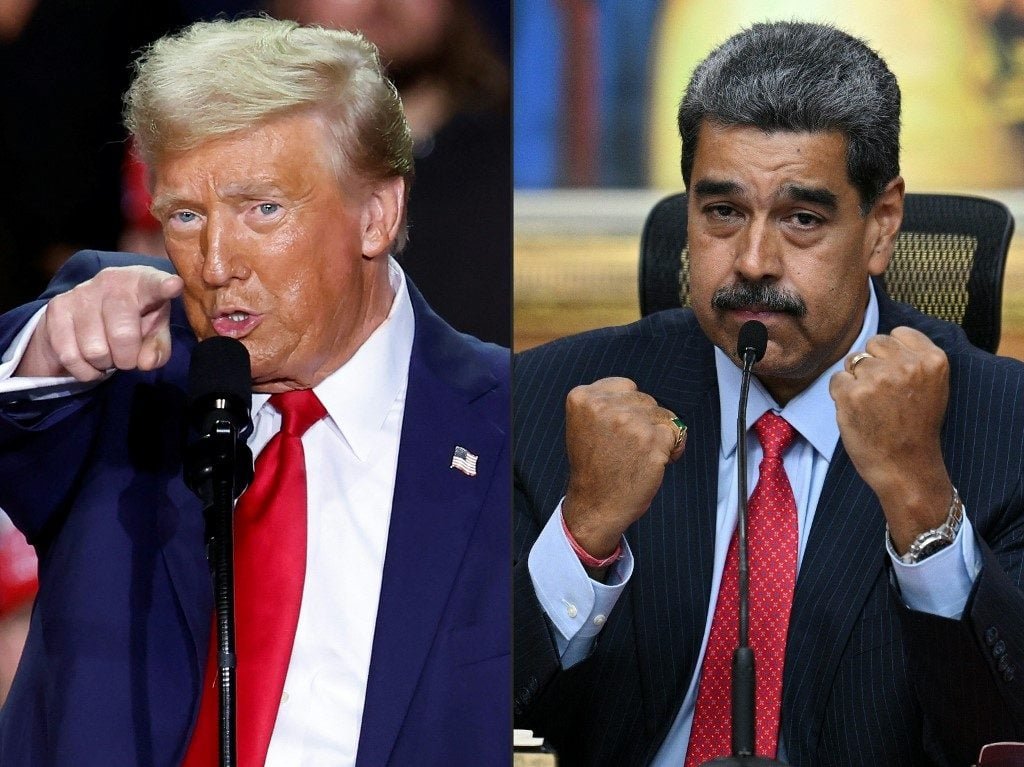
U.S. attack on Venezuela has rapidly become the dominant international headline, with explosions reported around Caracas and other regions.
Trump announced the operation on social media and said further details would be provided at a press conference.
This unprecedented confrontation marks a major escalation in tensions between Washington and Caracas.
Background: Long-Standing U.S.–Venezuela Tensions
The U.S.–Venezuela relationship has deteriorated over several years amid mutual accusations and sanctions.
The Trump administration had repeatedly charged Maduro with drug trafficking, narco-terrorism, and corruption.
Washington placed Maduro and key Venezuelan officials under sanctions for years, claiming links between the Venezuelan government and criminal networks.
In late 2025, the United States escalated pressure by striking suspected drug trafficking vessels and targeting alleged logistical hubs linked to criminal groups operating from Venezuelan ports.
The U.S. also deployed significant naval and air assets to the Caribbean region.
This weekend’s strike appears to be the most significant confrontation to date, expanding the conflict from targeted interdictions to direct military action on Venezuelan soil.
What Happened During the Strike
According to U.S. statements, explosions and low-flying aircraft were heard in Caracas early Saturday morning local time. President Trump posted that the United States successfully executed a “large-scale strike” against Venezuela and that Maduro and his wife, Cilia Flores, were captured and removed from the country.
U.S. officials later indicated elite special forces, reportedly the Army’s Delta Force, carried out the capture. The operation also targeted key military and strategic facilities in Caracas and surrounding areas.
Trump asserted the operation was conducted “in conjunction with U.S. law enforcement,” though details about the legal justification and congressional approval were not immediately clear in early reports.
Venezuelan Government Response and Conflicting Claims
The Venezuelan government has strongly rejected the U.S. narrative. Vice President Delcy Rodríguez stated that Venezuelan authorities did not know the whereabouts of Maduro or Flores and demanded “proof of life.” Caracas has also described the U.S. operation as a serious violation of its sovereignty.
Defense officials in Venezuela have called for mobilization and resistance, and the government declared a state of emergency following the attacks. These responses suggest internal uncertainty and alarm about the unfolding situation.
Independent confirmation of Maduro’s status remains limited in the early hours after the strikes. International media outlets continue to report conflicting information from Venezuelan officials and U.S. authorities.
Legal and Constitutional Questions Raised
U.S. military action inside Venezuelan territory raises significant legal questions. Analysts point out that deploying military force without explicit congressional authorization could strain constitutional norms in the United States and international law regarding sovereignty and the use of force.
Trump’s administration has argued in the past that presidential powers under the U.S. Constitution allow for limited military operations when national security is at stake, though this interpretation is often contested. Critics in Washington have already questioned whether the strike was legally justified and whether sufficient oversight occurred.
Global Reactions and Diplomatic Fallout
Global reactions have been swift and polarized. Nations such as Russia and Iran condemned the U.S. strike as a breach of international law, labeling it an act of aggression. These governments have called for emergency discussions at the United Nations Security Council.
Some U.S. allies expressed caution, emphasizing the need for clarity and restraint. Latin American leaders have voiced concern about regional stability and the humanitarian consequences of the conflict. Others, including right-leaning governments in the region, have supported the removal of Maduro, citing alleged corruption and authoritarianism.
What This Means for Canada and Canadians
The U.S. military strike on Venezuela and reported capture of Maduro matters to Canadians for several reasons:
- Regional Stability: Venezuela is a key country in Latin America. A military conflict could destabilize the region, affecting migration patterns and economic ties. Canada has diplomatic and humanitarian interests in Latin America and could face increased refugee flows or political pressures.
- International Law Precedent: Direct military action by one state against another without broad international backing raises questions about norms governing sovereignty and conflict. Canadians follow these developments due to Canada’s role in NATO and the United Nations.
- Economic Impact: Venezuela holds significant oil reserves. Disruption in the country’s governance and security could influence global oil markets, indirectly affecting Canadian energy sectors and consumer prices.
- Diplomatic Positioning: Canada must consider how to position itself amid international condemnation and support for the U.S. action. Ottawa’s diplomatic response could shape Canada’s relationships with both Western allies and Latin American partners.
The Human Cost and On-the-Ground Impact
Early reports from Caracas describe explosions, civilian fear, and infrastructure damage. While precise casualty figures have not been confirmed, witnesses reported significant disruption during the strikes. Civilians in major cities experienced blasts and power outages.
The Venezuelan government’s call for citizens to defend the nation underscores the risk of wider conflict and internal unrest. Humanitarian concerns are rising, with health services already strained and communications disrupted.
What Comes Next
In the coming hours and days, several developments will be critical to watch:
- Official confirmation of Maduro’s status from neutral or international sources.
- Details from Trump’s scheduled press conference on the legal basis and objectives of the operation.
- International diplomatic responses, especially at the United Nations.
- Potential counter-actions by Venezuela’s loyalist forces or allied states.
- Humanitarian assistance planning from global NGOs and neighboring countries.
This event represents a major shift in Western military engagement in Latin America. Its consequences for regional geopolitics, law, and civilian well-being will unfold in the coming weeks.