


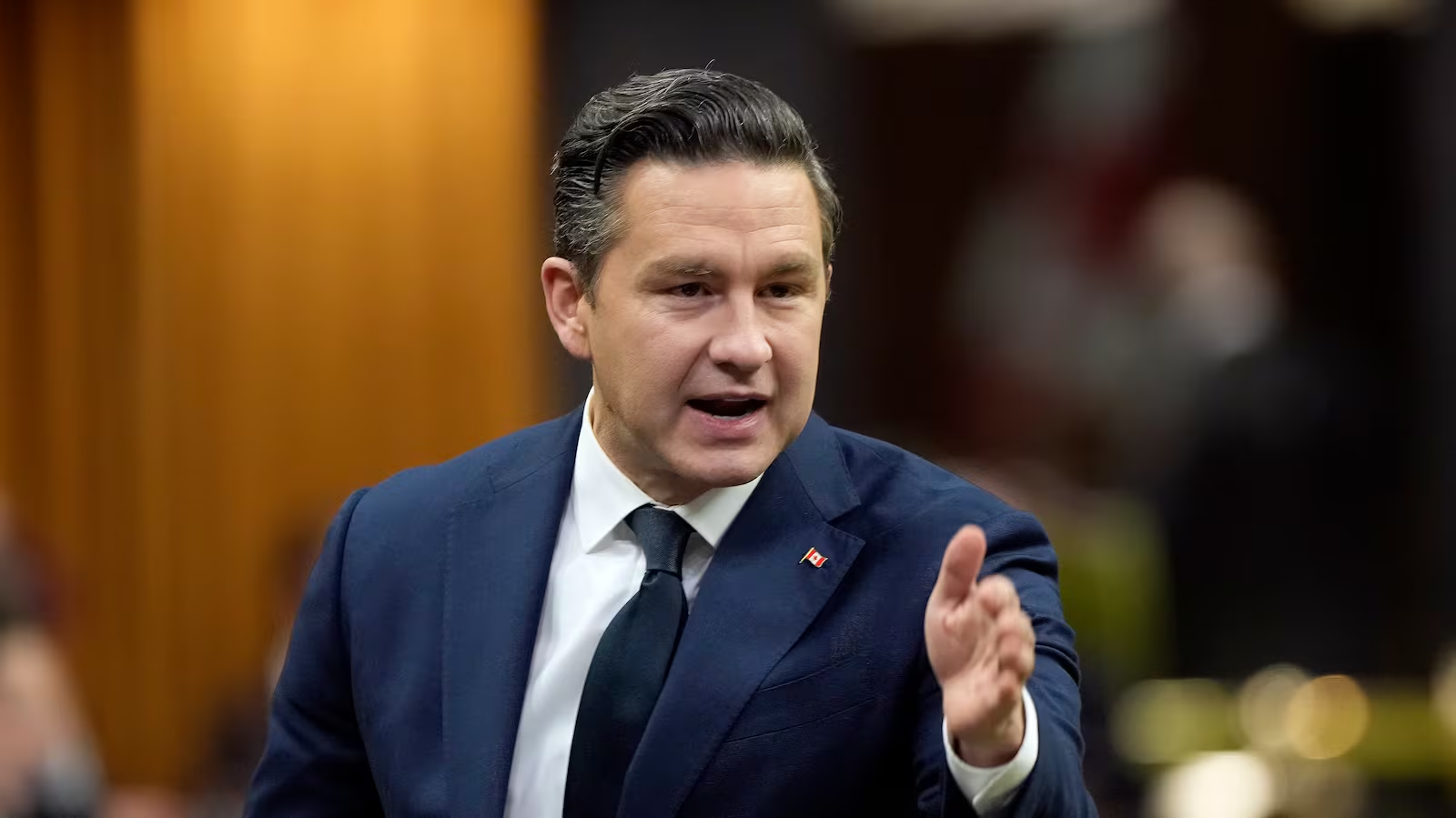
Poilievre made the remarks in a recent interview and at public events, asserting that the RCMP’s leadership hindered criminal charges against Trudeau over historic controversies. His comments have stoked a fierce political debate about accountability, policing independence, and the rule of law in Canada.
The statements have drawn both support from some Conservatives and sharp criticism from opposition parties and institutional defenders.
Poilievre’s Claims About RCMP and Trudeau Controversies
Pierre Poilievre said the RCMP “covered up” for Justin Trudeau, claiming police leadership failed to enforce criminal law in several high-profile cases. He suggested that if the RCMP “had been doing its job,” Trudeau would have faced criminal charges.
Specifically, Poilievre referenced two controversies from Trudeau’s time in office: the SNC-Lavalin affair and the 2016 Aga Khan vacation.
In the SNC-Lavalin case, federal ethics officials found Trudeau contravened conflict-of-interest provisions when trying to influence the prosecution of the Quebec engineering firm.
While Trudeau’s ethics breaches were documented, no criminal charges ever followed after RCMP investigation.
In the Aga Khan situation, Trudeau accepted a vacation from a billionaire donor whose foundation received federal funding, which also led to an ethics finding but no criminal referral.
In his comments, Poilievre also described RCMP leadership as “despicable,” although he later said he did not directly accuse the rank-and-file force of corruption. He clarified that his criticism targeted former RCMP commissioner Brenda Lucki for her handling of investigations.
Political Reactions and Calls for Apology
Opposition parties immediately responded to Poilievre’s remarks with criticism and demands for an apology. Liberal, Green, and New Democratic Party (NDP) leaders called on him to retract his comments and defend confidence in Canada’s police institutions.
Liberal House Leader Steven MacKinnon told reporters that accusing the RCMP of a cover-up undermines trust in law enforcement and judicial independence.
He pressed Poilievre during question period, asserting that such allegations are inappropriate without evidence.
Despite the calls for apology, Poilievre dismissed the criticism as a diversion from the governing Liberal Party’s record on inflation and economic issues. He has not issued a formal apology and reaffirmed his position at times when questioned by journalists.
The RCMP’s Institutional Response
The RCMP has publicly defended its professional independence and integrity. Commissioner Mike Duheme stated that the force does not take orders from political actors and that investigations into Trudeau-era issues were conducted based on evidence.
Law enforcement officials emphasize that decisions not to prosecute historically rested on the sufficiency of evidence, not political interference.
In the SNC-Lavalin matter, for instance, prosecutors and investigators concluded there was insufficient basis for criminal charges after thorough review.
These institutional responses underscore the distinction between ethics violations and criminal conduct, a nuance that public debates often blur.
Experts say equating ethical breaches with prosecutable offences misrepresents how Canada’s legal system functions.
Historical Context: Ethics vs. Criminal Enforcement
The controversies Poilievre referenced date back to events throughout Trudeau’s decade in office. Both the SNC-Lavalin saga and Aga Khan vacation involved ethics commissioner findings rather than criminal proceedings.
The ethics commissioner’s role is to enforce conflict-of-interest rules, which differ from criminal statutes enforced by police.
When ethics rulings occur, they do not automatically translate into criminal liability under the Criminal Code.
Legal analysts note that the RCMP consistently evaluated evidence before deciding against charges in these matters.
n the SNC-Lavalin investigation, limited evidence and constraints on access to internal Cabinet documents affected prosecutorial options.
This distinction helps explain why ethics breaches can coexist with decisions not to pursue criminal charges.
It also contextualizes why Poilievre’s language has sparked debate over legal accuracy.
Strategic Timing: Politics and Public Messaging
Poilievre’s comments reflect broader political strategy as he positions himself ahead of a leadership review within the Conservative Party in early 2026. Observers suggest the rhetoric aims to energize his political base by emphasizing accountability and criticism of political elites.
Conservative supporters have at times embraced Poilievre’s combative style, seeing it as a contrast to centrist or Liberal governance. However, critics argue that accusing institutions like the RCMP without substantiated evidence risks eroding confidence in Canada’s democratic norms.
Political commentators note that such remarks can deepen partisan divides ahead of future federal elections, a period when national unity and institutional trust are especially important. This backdrop amplifies the stakes of public accusations involving policing and political figures.
Legal Experts on Accountability and Evidence
Legal scholars point out that allegations of criminal conduct require clear proof and due process. Procedural safeguards in Canada ensure that police, prosecutors, and courts independently assess evidence before proceeding with charges.
Accusations that RCMP “covered up” criminal activity imply conspiracy rather than investigative judgment, a serious claim in a rule-of-law democracy. Experts caution that blurring the lines between ethics, administration, and criminal law can mislead the public about legal standards.
Moreover, they stress that public confidence in law enforcement relies on transparency and respect for due process. Calls for accountability must respect legal frameworks and established evidence thresholds.
Consequences
This controversy touches on Canadians’ trust in public institutions and the rule of law. The RCMP is one of the country’s foremost national security and policing bodies, and its perceived independence matters to citizens across the political spectrum.
Public trust in the justice system affects how Canadians view police, prosecutors, and political leaders. When political leaders make serious allegations without clear evidence, many Canadians worry about destabilizing confidence in core democratic systems.
The debate also highlights how ethical findings differ from criminal guilt in Canadian law. Understanding these distinctions equips citizens to assess political arguments more critically.
Finally, how Canada’s political leadership discusses accountability, transparency, and law enforcement could shape future elections and institutional reforms. This episode underscores the importance of measured public discourse in a democratic society.